
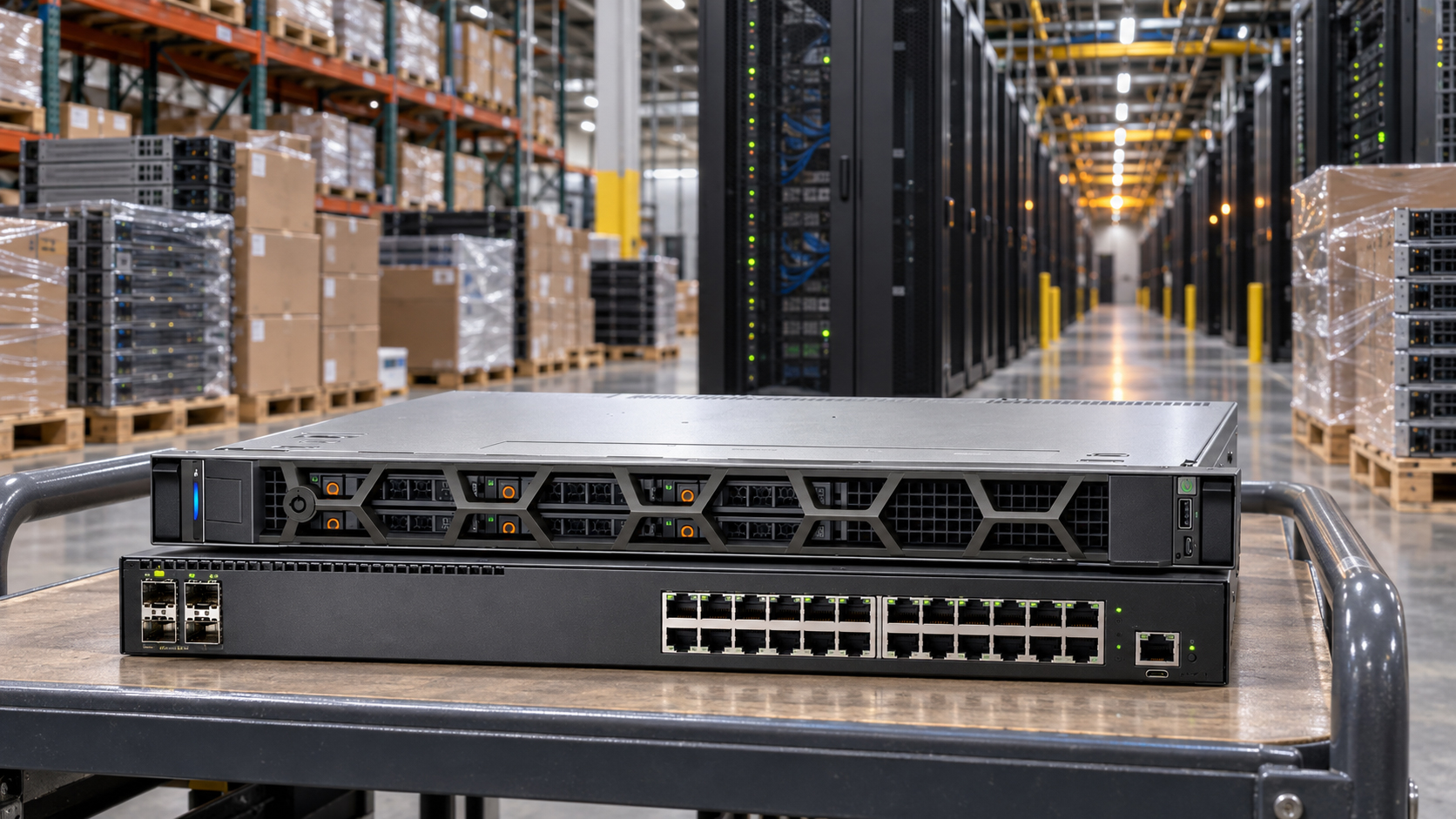
Your customer isn’t building an AI cluster.
They aren’t ordering racks of GPUs or training a large language model. They may just need a few servers, additional storage, new switches, or replacement hardware for an existing environment.
But increasingly, that doesn’t mean they’re insulated from the AI infrastructure boom.
The enormous investment flowing into AI and data center infrastructure is putting pressure on components and manufacturing capacity used throughout the broader IT hardware market. For VARs and solution providers, the result can show up in a much more familiar place: the next customer quote.
AI Demand Doesn’t Stay in the AI Data Center
It’s easy to think of the AI infrastructure buildout as a separate market dominated by GPUs and specialized systems.
The reality is much broader.
AI infrastructure requires enormous quantities of memory, storage, servers, networking equipment, optics, and other components. As manufacturers prioritize capacity for these high-demand applications, the effects can ripple into conventional enterprise hardware.
Memory is a particularly good example.
TrendForce has reported that AI and data center demand continues to drive tight memory supply, with manufacturers prioritizing server applications and reallocating capacity toward higher-performance products. Conventional DRAM contract prices were forecast to rise another 13% to 18% quarter over quarter in Q3 2026, while NAND Flash contract prices were expected to increase another 10% to 15%.
Those increases follow even sharper price movements earlier in the year.
And the pressure isn’t limited to components destined for specialized AI systems. General-purpose x86 servers and conventional server memory are increasingly part of the infrastructure supporting AI inference and other emerging workloads.
In other words, AI demand is increasingly competing for resources used by everyday enterprise IT.
Networking Is Feeling It, Too
The same dynamic is beginning to appear in networking.
Cisco recently described a “networking supercycle” underway, reporting that networking product orders increased 40% year over year during its fiscal fourth quarter. At the same time, the company reported $9.3 billion in AI infrastructure orders from hyperscalers during fiscal 2026.
That combination matters.
The industry isn’t experiencing only an AI infrastructure buildout. Enterprises are also refreshing aging networks, expanding data centers, increasing bandwidth, and deploying new applications.
All of that infrastructure has to connect.
That means switches, transceivers, optics, and other networking hardware can increasingly find themselves in the middle of several demand cycles at once.
Your customer’s five-switch expansion project may have nothing to do with AI. The supply chain producing and supporting those switches doesn’t necessarily have that luxury.
What This Means for VARs
For VARs, the important takeaway isn’t that every piece of IT hardware is suddenly going to become unavailable.
It’s that sourcing flexibility matters more when markets become unpredictable.
A quote that worked three weeks ago may not work today. A server configuration that fit comfortably within the customer’s budget may become more expensive because memory and SSD costs increased. A networking project may encounter an unexpected lead time.
And a customer that simply wants to add capacity to an existing environment may have little interest in waiting for the supply chain to catch up.
When that happens, there are generally three options:
Wait. Sometimes the customer can push the project out until availability improves.
Pay more. Sometimes the equipment is available, but the economics of the deal have changed.
Look for another sourcing path. Existing inventory, overstock equipment, professionally refurbished hardware, and alternative supply channels can sometimes provide options that aren’t available through the traditional distribution path.
That third option is becoming increasingly important.
The Hardware Already in the Market Matters
One of the advantages of the secondary IT hardware market is simple: the equipment already exists.
It isn’t waiting for additional semiconductor capacity. It doesn’t need to be manufactured next quarter. And in many cases, it isn’t tied directly to today’s OEM pricing structure.
That doesn’t mean secondary sourcing is the right answer for every project.
But when a customer needs additional switches for an existing network, replacement servers, storage capacity, transceivers, or other infrastructure, checking available secondary-market inventory can uncover options that might otherwise be missed.
It can also help VARs solve a problem without unnecessarily changing the customer’s architecture simply because the traditional supply path became expensive or constrained.
Don’t Wait Until the Quote Is in Trouble
The bigger lesson from the current hardware market may be that alternative sourcing shouldn’t be treated solely as an emergency option.
If AI infrastructure investment continues absorbing memory, storage, networking, and server capacity, VARs may increasingly benefit from checking multiple sourcing channels before a price or availability problem threatens the deal.
The traditional channel remains an important part of IT procurement.
It just doesn’t have to be the only one.
For VARs and solution providers, that means considering alternative sourcing earlier in the sales process. Even when traditional distribution has the product available, knowing what other inventory exists can provide another point of comparison on price, availability, and lead time.
And when the traditional channel can’t deliver what the customer needs, having that relationship already established can make it much easier to keep the opportunity moving.
More Sourcing Options in a Changing Hardware Market
The AI infrastructure boom may be reshaping the hardware market, but your customers still have everyday IT projects that need to get done.
They still need to replace failed equipment, add switches, expand server or storage capacity, and keep existing environments running. Budgets and deadlines still matter, and customers still expect their technology partners to find solutions when the obvious sourcing path doesn’t work.
SmartSource IT provides VARs, MSPs, and IT resellers with access to cost-effective overstock and professionally refurbished enterprise hardware, including networking equipment, servers, storage, and network transceivers from leading manufacturers.
We work alongside your existing distributor relationships, providing another sourcing option when pricing, availability, lead times, or product lifecycle challenges make traditional sourcing more difficult.
Before you tell your customer the price went up, the lead time got longer, or the hardware isn’t available, let us take a look.
About SmartSource IT
SmartSource IT helps VARs, MSPs, and IT resellers source cost-effective overstock and professionally refurbished enterprise hardware, including network transceivers, servers, networking equipment, storage, and other hard-to-find technology. We work alongside your existing distributor relationships, providing another strategic sourcing option when traditional channels encounter inventory, pricing, or lead-time challenges.
related posts

A customer comes to you with what sounds like a straightforward request: they want to upgrade their wireless network. At first glance, the opportunity may [...]

When a hardware deal falls apart, it's easy to blame price. Sometimes that's accurate. More often, though, price is simply the last symptom of a [...]
