

For many organizations, hardware maintenance renewals happen almost automatically. The renewal notice arrives, someone reviews the price, and if the equipment is still running, the contract gets renewed.
But there’s a point in the hardware lifecycle when that routine deserves a closer look.
As enterprise infrastructure ages, the economics of OEM maintenance can change significantly. Support costs may increase even while the equipment continues to perform reliably and meet the organization’s needs.
That creates an important question for VARs and MSPs to ask their customers:
Are we still paying for the level of OEM support this equipment actually needs?
For the right infrastructure, third-party maintenance (TPM) can provide another answer—helping customers reduce support costs, extend hardware lifecycles, and make refresh decisions on their own timeline.
It can also create an entirely new recurring revenue and margin opportunity for the technology partners advising them.
The Hardware Lifecycle and the Support Lifecycle Aren’t the Same Thing
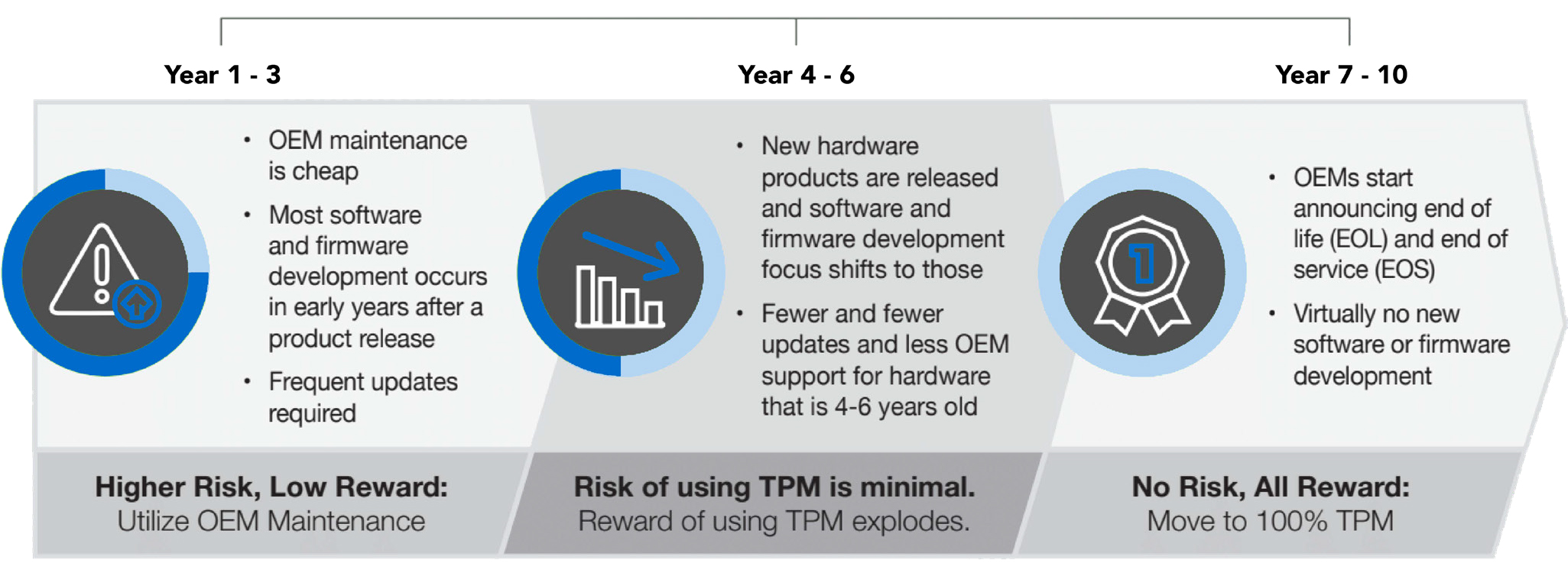
OEM maintenance makes sense for a lot of equipment, particularly earlier in its lifecycle. Manufacturers provide access to updates, engineering resources, replacement parts, and other services that may be especially valuable while a platform remains actively developed.
But hardware doesn’t suddenly stop being useful because it reaches a manufacturer-defined lifecycle milestone.
Servers, switches, storage systems, and other enterprise infrastructure can continue performing reliably for years after their initial deployment. Meanwhile, the economics surrounding that equipment continue to change.
Replacement parts may become more readily available. Software and firmware development may slow. The customer’s environment may stabilize. Yet OEM maintenance costs can remain substantial or even increase as the platform ages.
Eventually, the value equation deserves to be reevaluated.
That’s where TPM enters the conversation.
A Third Choice Between Renew and Replace
When aging infrastructure reaches a maintenance decision point, customers often see two options:
- Renew the OEM maintenance contract.
- Replace the equipment.
There’s a third option.
Eligible equipment can transition to third-party maintenance, allowing the customer to continue operating infrastructure that still meets its needs while maintaining access to technical support and hardware replacement services.
Through SmartCare from SmartSource IT, VARs and MSPs can provide customers with:
- Potential savings of 50%–85% compared with OEM maintenance.
- 24/7 expert technical support with access to certified engineers.
- Flexible SLA options designed around the customer’s operational requirements.
- Multi-OEM coverage that can consolidate support across different manufacturers.
- Extended hardware lifecycles that allow organizations to refresh infrastructure when it makes business sense—not simply because an OEM support milestone has arrived.
The objective isn’t to move everything away from OEM support.
It’s to identify where the economics of OEM maintenance no longer align with the value the customer is receiving.
One Environment. Multiple Support Decisions.
Modern IT environments rarely consist of equipment from a single manufacturer purchased at the same time.
A customer may have Cisco switches deployed five years ago, newer HPE servers, Dell infrastructure approaching a maintenance renewal, and storage equipment that remains perfectly adequate despite reaching an OEM lifecycle milestone.
Treating every asset the same way doesn’t necessarily make sense.
SmartCare supports networking, server, and storage infrastructure across a broad range of enterprise manufacturers, including Aruba, Arista, Brocade, Cisco, Dell, Extreme Networks, HPE, Juniper, Lenovo, NetApp, Nutanix, Oracle, and Supermicro.
SmartCare can also extend beyond physical infrastructure with third-party technical support for VMware vSphere and vCenter environments.
That allows partners to look at the customer’s environment more holistically and ask a better question:
Which assets still benefit from OEM support, and which could be supported more economically another way?
The answer may be different for every piece of infrastructure.
That’s the point.
TPM Doesn’t Have to Be an All-or-Nothing Decision
One misconception about third-party maintenance is that choosing TPM means abandoning OEM support across the environment.
It doesn’t.
A hybrid support strategy can often make considerably more sense.
Newer, mission-critical infrastructure may remain under manufacturer support while mature, stable equipment transitions to TPM. End-of-life hardware can continue receiving support while the organization plans a future refresh. Different systems can follow different support strategies based on their actual operational importance.
This gives customers more control over where they’re spending maintenance dollars.
It also changes the VAR or MSP’s role from simply processing renewals to actively helping the customer optimize the economics of their infrastructure.
There’s a Revenue Opportunity Hiding in the Installed Base
VARs naturally spend a lot of time looking for the next hardware refresh.
But there’s another opportunity sitting inside equipment that’s already been sold.
Every server, switch, storage array, and network platform in a customer’s environment eventually reaches a support decision point.
Some of those assets will be refreshed.
Some will remain under OEM maintenance.
And some may be excellent candidates for TPM.
Identifying those opportunities creates a new conversation with an existing customer—and potentially a recurring source of revenue that doesn’t depend on waiting for the next major hardware purchase.
Instead of approaching the customer with another product to buy, you’re bringing them an opportunity to potentially reduce an expense they already have.
That’s a compelling conversation.
Start With the Next Renewal
Finding a potential SmartCare opportunity doesn’t require a complicated infrastructure assessment.
Start with the customer’s next maintenance renewal.
Look for equipment that is several years into its lifecycle, out of warranty, approaching End of Life (EOL) or End of Service (EOS), or becoming increasingly expensive to maintain through the manufacturer.
Then ask a simple question:
Does continuing OEM maintenance still make economic and operational sense for this equipment?
If the answer isn’t obvious, compare the options.
Provide SmartSource IT with the equipment requiring coverage, obtain SmartCare pricing, and compare the available support and service levels against the customer’s current maintenance arrangement.
Maybe OEM support remains the right choice.
Maybe TPM produces significant savings.
Either way, you’ve helped the customer make an informed decision instead of simply processing another renewal.
Make the Hardware Lifecycle Work for Your Customer
The goal of third-party maintenance isn’t to keep aging equipment running forever.
It’s to give customers more control over when and why they replace it.
If infrastructure continues to meet the organization’s performance, reliability, and operational requirements, an expensive maintenance renewal shouldn’t automatically dictate the refresh schedule.
SmartCare gives VARs and MSPs another option to bring to that conversation—one that can lower support costs, extend the useful life of existing investments, simplify multi-vendor support, and create additional recurring margin.
Before your customer’s next OEM maintenance renewal becomes automatic, take another look at the equipment being covered.
There may be a better way to support it.
Explore SmartCare
SmartCare from SmartSource IT provides third-party maintenance for networking, server, and storage infrastructure, along with third-party technical support for VMware vSphere and vCenter environments.
If you have a customer approaching an OEM maintenance renewal, send us the equipment list. We’ll help you evaluate the opportunity, compare SmartCare coverage and pricing, and determine where third-party support may make sense.
